Miss Skiffins
Great ExpectationsMiss Skiffins is John Wemmick’s frequent visitor at his home in Walworth, a capable and composed woman whose courtship with him unfolds amid the household’s small mechanical contrivances and rituals. She later becomes Mrs. Wemmick. Her marriage brings Wemmick’s private attachment into view without erasing the boundary he maintains between the Castle and his working life in Little Britain.
Identity and Introduction
Miss Skiffins works, like Wemmick, in the post-office branch of the service. She is described as perhaps two or three years younger than he is, with a wooden appearance and a dress whose orange fabric and green gloves make a striking impression. The narrator judges her to possess portable property, but also finds her a good sort of fellow; her evident regard for Wemmick’s Aged Parent gives her first appearance a domestic warmth beyond the narrator’s amused appraisal of her clothes.
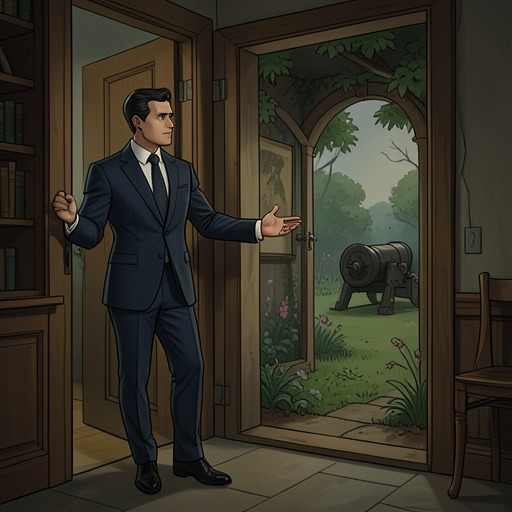
Her place in the Castle is already established when Wemmick introduces her to the narrator across the moat. She is a frequent visitor, and the little doors in the wall announce her by name, opening and shutting in a sequence that can display her and Wemmick together. Wemmick made these devices himself, and he says that only the Aged, Miss Skiffins, and he know the secret of their pulls. The private mechanism is both a playful convenience for the old man and a sign of the couple’s shared familiarity with the house.
Courtship at the Castle
The Castle scenes show an intimacy shaped by Wemmick’s humor and Miss Skiffins’s unruffled authority. While the Aged reads the newspaper, Wemmick gradually tries to put his arm around her waist. Miss Skiffins stops him with her green-gloved hand, removes his arm as calmly as if it were a garment, and lays it on the table. When he tries again, she repeats the maneuver. Her composure turns the episode into a measured comic pattern: Wemmick pursues, and she quietly restores the boundary.
Yet the restraint is not a refusal of closeness. After the Aged nods into a light slumber, Miss Skiffins helps prepare a warm drink, and she and Wemmick share a glass. The narrator leaves before accompanying her home, understanding that this is not his place. The episode presents the couple’s attachment not through a declaration but through repeated visits, familiar household routines, and a degree of intimacy that becomes visible in the presence of Wemmick’s father.
Miss Skiffins also becomes part of the practical help Wemmick offers the narrator. When asked to assist with a financial arrangement, Wemmick distinguishes his private capacity from his trade and says that Miss Skiffins’s brother is an accountant and agent whom he can approach. Her family connection supplies a concrete route to the business arrangement, while Wemmick’s insistence that the matter belongs to private life preserves his separation of home from office.
Marriage and Private Life
The narrator later sees Wemmick in the street and mentions Miss Skiffins. Wemmick’s sly look and self-conscious flourish suggest that the subject touches a private attachment he has not fully left behind, even after their relationship has become known to his friend. His response is characteristic: his personal life remains something to be guarded from the habits and scrutiny of the office.
When Wemmick marries her, the ceremony is arranged to look almost unplanned. He produces white kid gloves, then discovers a ring from his waistcoat pocket as the service is about to begin. Miss Skiffins exchanges her usual green gloves for white ones, while the Aged is tasked with giving her away. He does not understand the point in the service when the clergyman asks who gives the bride; Wemmick has to prompt him. Once the ceremony is complete, Wemmick places his white gloves in the church font, while his new wife puts hers in her pocket and resumes wearing green. The contrast captures the ceremony’s public form and the couple’s continuing ease with their private habits.
At breakfast after the wedding, Wemmick jokes that the food is provided by contract, but his manner toward his wife has changed: she no longer removes his arm when it settles around her. He praises her skill at managing fowls and promises that the narrator will receive eggs to judge for himself. The domestic detail gives their marriage a practical, companionable shape rather than a grandly romantic one.
Mrs. Wemmick and the Walworth Boundary
After the wedding, Miss Skiffins is identified as Mrs. Wemmick. Wemmick’s pride in her and in their home life is real, but he marks it as a Walworth sentiment, not something to be mentioned in Little Britain. He worries that Mr. Jaggers might think his brain was softening if he knew of the domestic attachment. The joke makes the distinction more than a change of address or manner: Wemmick protects private affection from the professional persona he maintains at the law office.
Her marriage therefore gives the Castle a household partnership and makes visible the private warmth that Wemmick keeps apart from his official self. Miss Skiffins’s practical manner, closeness to the Aged, and steady presence in the Castle all belong to that home world. The ending confirms that Wemmick’s guardedness does not mean an absence of feeling; his affection is expressed in the domestic life he shares with his wife, and preserved by the boundary he insists on keeping around it.